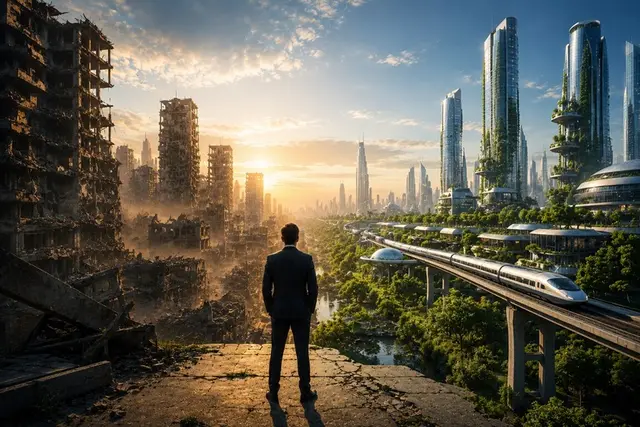
Top 10 Urban Living Trends That Will Change Cities Around The World By 2026/27
Humanity has always had cities as its most intricate and significant invention. They are the place to gather ideas, people solutions, concerns, and possibilities in ways that only one other form of human settlement has the capacity to match. The urban scene of 2026/27 will be formed by a variety circumstances that’s both exciting and challenging. They include global warming demands fundamental shifts in the way that cities are constructed and run, technology offering new ways of dealing with urban complexity, evolving ways of working and mobility altering how people utilize city space, and a growing demand for urban spaces that work better for the people who live there instead of just passing across or planning to invest in these cities. The following are the ten most important urban living styles that are changing cities around the world by 2026/27.
1. The Fifteen-Minute City Concept Gains Practical Traction
The idea that urban living is to be arranged so that everything one needs on a regular basis like work, education healthcare, shopping and green spaces, along with social infrastructure, are accessible within 15 minutes of walking or cycling distance from home. It has moved out of the realms of urban planning and theory into practice in a growing the number of city. Paris is the most frequently cited example, however versions of the idea are being implemented throughout Europe, Latin America, and even in parts of Asia. Certain critics have raised questions about the potential for such models to restrict movement but the fundamental idea, designing cities based on human-scale and life-styles, not car dependency, is gaining the support of the mainstream.
2. Housing Affordability Motivates Bold Policy Experiments
The crisis in housing affordability that is affecting major cities throughout the world is at a point where it calls for policy responses much more ambitious than the ones seen in recent years. Zoning changes, density bonuses, the requirement of affordable housing to be met and land value taxation mass-scale construction of social housing as well as restrictions on leasing platforms for short-term rentals are being used in a variety of combinations as cities seek out strategies that are able to meaningfully change the dial. It is not clear which approach has been to be effective in all cases, and the political economy of reforms to housing remains debated. The realization that doing nothing is no choice anymore is the basis for a period of policy experimentation, which, with time, is beginning to yield results.
3. Green Infrastructure Becomes Core Urban Design
Urban greening has grown from a thoughtless cosmetic feature to an essential component of how cities plan for climate resilience, well-being, and accessibility. Tree canopy growth, green walls and roofs, urban waterways, pocket parks and daylighting of underground waterways are all being incorporated into urban design at which scales that reflect the multiple purposes the green infrastructure serves. It decreases the urban heat island effect, controls stormwater, improves air quality, increases biodiversity and creates tangible benefits to mental and physical health of urban residents. Cities that invested in green infrastructure just a decade back are already demonstrating benefits that are speeding up adoption elsewhere.
4. Urban Mobility Changes around Active and Shared Travel
The private car’s dominance of urban areas is now being challenged in a more severe manner than at any before. The number of cyclists is increasing rapidly and in many cities of Europe as well as expanding to other regions. E-bikes and escooters have become essential components the urban transport system in a number of cities. In the last few years, public transportation investment has increased in response to both climate goals and the recognition the fact that car-dependent towns are unable to operate efficiently at the scale that urban expansion requires. The transformation process isn’t always smooth and often contentious. However, the direction is apparent: cities are gradually recovering space from private automobiles and redistributing it to the public actively traveling, active travel and more shared mobility options.
5. Mixed-Use Development Replaces Single Use Zoning
The legacy of twentieth century urban planning, which rigidly separated residential industrial, commercial, and residential zones, is now being reversed in cities after cities. Mixed-use development which includes housing, work spaces together with hospitality, retail and community facilities within the same areas and buildings provides more livable, walkable and economically stable urban environments. This change is being accelerated by the waning the demand for offices with single-use facilities as well as monocultures of retail, resulting from changes to the ways people work and shop. Business districts that were once dominated by businesses are now being renovated as mixed communities, and new development is increasingly necessitated to integrate a variety kinds of uses right from the start.
6. Smart City Technology Matures Into Practical Use
The smart city idea spent many years creating more hype than real results. Its ambitious sensor devices and networks frequently struggle to bring tangible improvements for urban living. The evolution of technology and a more sensible approach to deployment is resulting in more useful and practical applications. Intelligent traffic management that decreases pollution and congestion, predictive maintenance systems that tackle infrastructure issues before they turn into issues, real-time air quality monitoring which provides information for public health intervention and platforms for digital that facilitate access to city services have all been proven to be beneficial in cities that have implemented these systems with care.
7. Urban Food Production Scales Up
The growing of food in cities is now a rooftop activity to an integral part to the food and drink strategy of some of the world’s most forward-thinking municipalities. Vertical farms that employ controlled-environment agriculture produce lush greens and herbs in warehouses that have been converted and purpose-built buildings that require a fraction of the land or water required for conventional agriculture. Community gardens schools, gardens for children, and urban orchards have academic and social purposes as well as food production. The proportion of a city’s eating habits that can be fulfilled by urban production is still a bit limited however, the direction of development, toward shorter supply chains with greater security in food supply, and greater connection between urban residents and food systems is apparent.
8. Inclusion Design is Moving Up The Urban Agenda
The concept that cities need to be designed and constructed to function for everyone who lives there, including disabled children, as well as people with limited resources is receiving more the attention of urban planners. Age-friendly city frameworks with universal design standards, transport and public space design processes, co-design that involve communities that are marginalized in forming their areas, as well as affordability requirements that prevent the displacement of long-term residents from upgrading areas are being viewed with greater concern. The realization that a society that is primarily for able-bodied, the young, and the wealthy is not serving in a large portion of its population is leading to new and more inclusive models for urban planning and governance.
9. The Business of the Night Time Gets Smarter
Cities are paying more pay attention to what happens following darkness. The nighttime economy, which includes hospitality, entertainment as well as cultural venues and the service workers who ensure the functioning of cities all night long provides significant economic also having a cultural impact that’s historically been managed poorly. Night-time mayors who are dedicated or night-time economy commissioners currently in place in cities ranging from Amsterdam to Melbourne represent the interests night-time businesses and residents in a coordinated manner, mediating the conflict and crafting a policy to promote a nocturnal city without making life intolerable for those who must sleep. The framework is becoming more exportable and increasingly influential.
10. The notion of community And Belonging Drive Urban Renewal
Between the physical and technological aspects of urbanization lies the fundamental social problem. Many city residents, particularly within rapidly changing urban environments feel disconnected from the community around them. A growing proportion of urban practice is focused on constructing the social infrastructure, community centers market, libraries, public spaces, and activities that facilitate genuine human connection in dense urban environments. The most successful urban renewal programs that are currently in use include those that blend physical improvement and a sustained commitment to community building, realizing that a neighborhood is most importantly defined by its relationships and structures.
Cities will continue to be the most important arena in which the most significant challenges for humanity face and its largest opportunities are pursuing. The trends mentioned above don’t offer a utopia; the changes that they represent have been contested, limited and unevenly distributed in different urban contexts. But they point toward cities that are, in a growing number of places growing more livable eco-friendly, more sustainable, as well as more in tune with the needs of the people who reside there. For more detail, browse a few of the leading To find additional detail, head to a few of the top nyhetskanalen.nu/ and get reliable reporting.
Ten Real Estate Changes Reshaping Real Estate As We Know It In 2027
The real estate market has always been a reliable gauge to gauge broader socioeconomic and political trends, reflecting changes in the way people spend their time, live and allocate their resources more accurately that almost every other sector. The landscape of real estate in 2026/27 is shaped by distinctive mix of forces. the lingering effects of the cycles of interest that have shaped the affordability of most major markets along with the continuous evolution of how people use homes and workplaces and the climate that are starting to influence where and how property is valued, and the advancement of technology that is transforming how real property is handled, traded, and developed. Here are the ten real developments that are influencing the real estate market in 2026/27.
1. In the end, affordability remains the defining challenge In the majority of Markets
In the last few years, housing affordability is reaching high levels in a majority of major cities. It is a serious concern well way beyond even the most pricey cities. The combination of decades with a lack of supply in comparison to population expansion, the high current interest-rate environment of the early 2020s that repriced mortgages significantly upwards along with the costs of construction and land which have grown much faster than incomes across many markets has created a situation where homeownership has become real for an ever-decreasing portion of the population in the places where the people are most eager to live. Policy responses are growing and getting more aggressive, yet the fundamental mismatch between demand and supply at high-demand places is not one that can be fixed quickly regardless of the goals implemented to solve it.
2. Remote Work Continues to Shape The Place People Decide To Live
The ongoing availability of remote and hybrid working for a significant percentage of skilled workers has created an ongoing shift in residential lifestyle preferences, and continues to take place in the market for property. Secondary cities, commuter towns with good connectivity to transport, meaningfully lower property costs, and rural locales that provide an environment and quality of living that urbanization cannot all profit from the demand which was previously concentrated in the main employment centers. It is not a uniform effect and is largely dependent on sector delineation, job level, as well as employer policies, but the total impact on demand patterns within both urban cores, as well as areas surrounding them is clear and ongoing.
3. Build-To Rent Expands to Become A Major Asset Class
In the last few years, institutional investment in purpose-built housing has grown significantly creating a professionalisation process of the rental market in a variety of markets that is altering the renting experience in a significant way. Build-to -rent developments have professional management with amenities, flexible lease terms, as well as a consistency of standard that the limited private landlord market has historically struggled to deliver. If you are an investor, steady long-term income potential of residential rental properties has proven attractive. For renters, the market has improved quality and customer service however questions of cost and displacement of smaller landlords with properties that have lower value that those in institutional properties are valid concerns.
4. Sustainability and Energy Efficiency are now Fundamental Valuation Objectors
The energy performance of a property has become an important element in its market value and not being an unimportant consideration. Rising energy costs have made the difference in operating costs between efficient and inefficient houses important for buyers as well as renters. A growing number of stringent minimum energy efficiency requirements for rental properties are forcing the need to retrofit or threaten homes that have reached the point of being obsolete. Mortgage products with preferential rate for energy-efficient properties are starting to incorporate the sustainability benefits into the cost of financing. Properties with low energy efficiency ratings are being subject to increasing valuation discounts, which are incentive-based and begin to alter the way that existing value of the property is assessed and rated.
5. PropTech Transforms Transactions And Property Management
Technology is transforming the real estate process in ways that improve efficiency that are transparent, easy to access and accessible to both sellers and buyers. AI-powered valuation tools offer greater accuracy and speedier appraisals for property. Transaction platforms that use digital technology are helping to reduce the amount of time and hassle involved during conveyancing and title transfer. Virtual tours and augmented reality tools are enabling the evaluation of properties that is meaningful without physical visits. In property management, smart technology for building, predictive maintenance systems, and tenants experience platforms are enhancing the efficiency of managing assets and how tenants experience. The speed of innovation is slowed by the rigidity of an industry based upon vast assets and intricate regulations however it is expanding.
6. The Climate Risk Manifests Itself In the property value in locations that are vulnerable.
The financial implications of climate risks for property have begun to be apparent in specific markets in ways that are beginning to influence pricing, availability of insurance and mortgage lending decisions. Homes in areas of high fire risk, flooding or extreme heat risk will be paying higher premiums for insurance as well as in some instances the loss of insurance coverage as well as increased scrutinization by mortgage lenders to assess the quality of their long-term assets. The impact remains limited with a wide spread, but the direction is toward the inclusion of climate risk into property values rather than thought of as an exogenous uncertainty. For buyers, understanding the long-term climate risk profile for a specific location will soon be a standard part of due diligence, rather than an optional consideration.
7. The Office Market Continues Its Structural Adjustment
Commercial office real estate is in middle of a structural change which has no obvious historical precedent. The shift to hybrid-working has led to lower demand for office space and has also concentrated on the most high quality, most centrally located, and amenity-rich structures. The result is a market that has shifted sharply between superior office spaces that continue to fetch high rents and occupancy, as well as a lot of older, poorly-located or poorly designed buildings confronting a severe pressure to repurpose. The conversion of obsolete office buildings to hotels, residences, education and mixed uses is growing, though the financial and practical challenges for conversions mean that the growth rate isn’t as fast as the speed of the demand.
8. Multigenerational Living Experiences Make A Big Return
Pressure from the economy, shifting demographics and changing cultural beliefs regarding family structure are leading to an increasing number of family living arrangements for multiple generations in many markets. Adult children who remain in or returning to their home of the family for longer periods, older relatives moving into the home of adult children as a substitute for formal care, as well as deliberate choices to pool resources between generations in order to have property ownership that would not be possible on their own are all contributing towards the increasing the demand for homes able to accommodate multiple generations of adults in an the appropriate privacy and room. Planners and developers are starting to respond with the right products for the multigenerational lifestyle, rather than looking at it as a unique modification of standard family housing.
9. Housing Innovation focuses on the Supply Gap
The chronic undersupply of housing in highly-demand areas is causing exploration of building methods and homes that are built to deliver greater housing faster and cheaper than traditional construction. Modern construction methods, such as panels, modular construction, volumetric systems, and more advanced manufacturing techniques are gaining traction while the industry wrestles with the challenges of quality control, financing, and insurance hurdles that have historically hindered their use. Smaller dwelling typologies designed for changing household structures, co-living models that combine facilities across private units, and growth of previously ignored infill sites are all a part in a more comprehensive toolkit for addressing the issues of supply that conventional housebuilding can’t resolve on its own.
10. Real Estate Investment Becomes More Accessible
The barriers to real estate investment, which previously required substantial capital and direct ownership of property, is being reduced by financial technology that opens the asset class more to investors. Real estate investment trusts offer investors with a liquid exposure to diversified property portfolios via traditional investment accounts. Fractional ownership platforms permit investment in specific properties and require less capital commitments than direct purchases require. Tokenisation of real estate assets by using blockchain technology has led to new forms of fractional ownership that have improved liquidity properties. To those seeking to secure the protection against inflation and income-generating qualities traditionally associated with investing in property, alternatives are now broader and more readily available than ever before.
The market for real estate in 2026/27 illustrates an environment in which the relationship between people and the environments in which they live and work is changing on a variety of fronts simultaneously. The trends mentioned above do not suggest a single, unified future for property markets but toward a sector that is more complex and diverse, as well as more responsive to wider environmental and social forces as opposed to the relatively stable years prior to the current phase of disruption. For buyers, sellers, the public and investors alike, understanding those forces and the direction they are moving is an crucial first step in navigating what comes next. For additional insight, visit these respected nyhedsforum.dk/ and get reliable analysis.